15 Min Read
- Key Takeaways
- What Happens to Your Breasts Immediately and Long-Term After Breast Implant Removal?
- 10 Key Questions to Ask Before Breast Implant Removal
- What Do Final Results Look Like After Implant Removal (With and Without a Breast Lift)?
- Recovery Timeline and What to Expect After Breast Implant Removal Surgery
- Why Choose Dr. Miguel Delgado, M.D. for Breast Implant Removal in San Francisco and Marin?
- Frequently Asked Questions About Breast Implant Removal Surgery
Whether you’re dealing with capsular contracture, a suspected rupture, breast implant illness symptoms, or simply ready for a change after years with implants, understanding what happens to your breasts after breast implant removal is the first step toward making a confident decision. This comprehensive guide is designed for women considering or preparing for explantation. It covers what to expect physically and emotionally after breast implant removal, including immediate and long-term changes, recovery, and answers to the most common questions. Understanding these changes is crucial for making informed decisions about your health, appearance, and overall well-being as you plan your next steps.
Key Takeaways
- Breasts will look smaller and flatter immediately after breast implant removal surgery, often with upper-pole emptiness and swelling that gradually improves over 3 to 12 months as tissues readjust.
- Implant size, how long implants were in place, skin elasticity, pregnancies, and weight changes can affect breast sagging and whether a breast lift is needed.
- Final results after implant removal surgery are usually visible within 6 to 12 months and can be significantly improved with options such as a breast lift or fat transfer.
- Breast implant removal can lead to changes in body image and self-perception as women adjust to their natural breast shape, and emotional responses post-explant surgery can include both relief and grief.
- Dr. Miguel Delgado in San Francisco and Marin County offers individualized plans for implant removal, capsulectomy, breast lift, and fat transfer, with a free virtual or in-office consultation.
What Happens to Your Breasts Immediately and Long-Term After Breast Implant Removal?
After breast implant removal, breasts undergo a significant transition as tissues readjust to life without a prosthetic. The good news is that what you see in the first few weeks is not your outcome — your body needs time to heal, settle, and reshape.
First 1 to 6 Weeks
Expect breasts to look noticeably smaller, with possible emptiness at the upper pole and mild to moderate sagging. Initial swelling and bruising are common right after breast implant removal surgery, and incisions are typically placed along previous augmentation scars or the breast crease. Breast tissue quality affects post-removal appearance during this early phase.
6 Weeks to 6 Months
Tissues begin to soften, and the skin starts to retract if elasticity allows. Many women describe a “fluffing” effect as breast tissue settles into the lower pole, creating a more natural slope. Scars begin fading from red or pink to lighter tones.
6 to 12 Months
The final appearance of the breasts after implant removal may take several months to stabilize as the skin and underlying tissue settle. For women in their 30s with moderate implant sizes, the results often appear sooner. Women in their 50s or those who had very large implants or long-standing implants (15 to 20+ years) may find that some breast tissue thinning, ptosis, or upper-pole flatness persists. In some cases, breast implant removal may return breasts to their original shape, especially when natural tissue volume was preserved.
Dr. Delgado reviews pre-implant photos, pregnancy history, weight fluctuations, and implant data to understand each patient’s breast appearance at the start of augmentation and provide a personalized prediction of post-removal results.

10 Key Questions to Ask Before Breast Implant Removal
Below are the 10 most common questions women ask Dr. Delgado before explantation. Use them as a starting point, and bring your own list to your consultation for a tailored discussion based on your implant age, size, and health concerns.
Will my breasts look smaller after breast implant removal?
- Breast implants add fixed volume, commonly 250 to 500, so removing them will always make breasts smaller immediately.
- Patients who started with an A or small B cup before augmentation often return to a similar cup size. Women who began with fuller natural breast tissue may still have a C cup or larger after explantation.
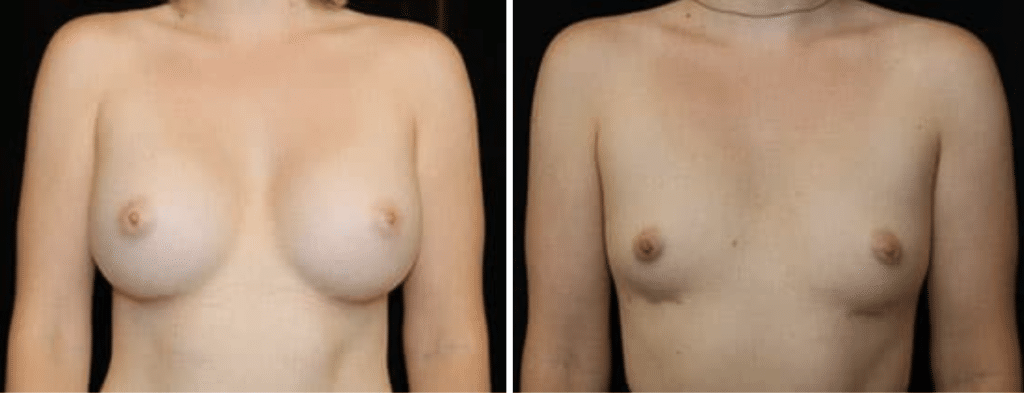
- Breasts may look smaller and flatter immediately after implant removal, but this “deflated” look typically improves as swelling resolves and tissue redistributes over weeks.
- Dr. Delgado can show real before-and-after photos of women with similar starting size, implant size, and body type to help set realistic expectations.
Will my breasts sag after my implants are removed?
- Skin laxity and sagging may occur after breast implant removal due to stretched skin, especially if implants were large (over 350–400 cc), placed for 10+ years, or if there have been pregnancies or weight fluctuations.
- Once the underlying implant support is gone, thinned breast tissue and stretched skin can lead to ptosis.
- Younger patients with smaller implants and good skin elasticity often experience less sagging and better spontaneous “bounce back.”
- Dr. Delgado assesses nipple position relative to the inframammary fold, areola size, and skin laxity in consultation to predict sagging and discuss whether a breast lift is recommended at the same time as implant removal.
Will I need a breast lift after breast implant removal?
- A breast lift (mastopexy) is not mandatory for every patient but is strongly considered when nipples sit below the breast crease or point downward once implants are removed. Excess skin may remain after breast implant removal, so a lift can help reshape the breasts.
- Combining breast implant removal and a breast lift in one operation means a single exposure to anesthesia, a single recovery, and immediate reshaping. Some patients prefer to stage the lift three to six months later to allow the tissues to settle first. Others choose to wait and see if the breast tissue retracts or improves before deciding on mastopexy.
- A lift reshapes the breast by removing extra skin, repositioning the nipple-areola higher on the breast mound, and improving roundness and projection.
- Dr. Delgado offers several lift patterns — periareolar “doughnut,” vertical “lollipop,” and full anchor — choosing the technique that balances scar length with the degree of correction needed. Combining removal with mastopexy produces significantly better aesthetic outcomes than removal alone, particularly in patients with lax skin.
Can I have fat transfer after breast implant removal?
- Fat transfer (autologous fat grafting) is a popular option to restore modest volume and fullness after implant removal, using fat harvested via liposuction from areas like the abdomen, flanks, or thighs.
- Realistic expectations matter: fat transfer typically adds about half to one cup, not the dramatic volume of large implants. Some of the injected fat (often 30–40%) is naturally reabsorbed over the first few months.
- Benefits include more natural-feeling breasts, improved contour in donor areas, and no foreign material left in the body.
- Dr. Delgado may recommend performing fat transfer at the same time as implant removal or as a staged procedure, depending on breast tissue quality, capsular contracture status, and overall health.
What is the difference between breast implant removal and a capsulectomy?
- Basic breast implant removal means taking out the implant only, leaving the surrounding scar tissue capsule in place if it is thin, soft, and not causing problems.
- Capsulectomy is the surgical removal of part or all of the capsule that forms around each breast implant. It may be needed when capsular contracture causes discomfort and warrants removal, or when rupture, calcification, or other suspected implant-related issues occur.
- There are several types: partial capsulectomy, total capsulectomy, and en bloc capsulectomy, meaning the implant and capsule are removed together, each with different levels of tissue removal and surgical complexity.
- Dr. Delgado tailors the implant removal and capsulectomy plan to the patient’s symptoms, imaging findings (e.g., MRI or ultrasound), and goals, prioritizing safety and comprehensive treatment.
Do I need an en bloc capsulectomy when my implants are removed?
- En bloc capsulectomy means removing the breast implant and entire capsule together in one piece, without opening the capsule, when technically and medically appropriate.
- En bloc removal is sometimes recommended for patients with ruptured silicone implants, confirmed BIA-ALCL (a rare cancer linked to textured implants), or strong concern about silicone gel leaking and capsule contamination. A BIA-ALCL diagnosis may require implant removal.
- En bloc surgery is not always possible or necessary. For example, with very thin capsules near the chest wall, the risk to nearby structures is higher, and safety always comes first.
- At your consultation, Dr. Delgado discusses the pros, cons, and realistic feasibility of en bloc capsulectomy, often reviewing imaging and past operative reports before finalizing the surgical plan.
What happens if my breast implant is ruptured?
- Saline implants and silicone implants behave differently when ruptured. Saline deflation is usually obvious as the breast quickly loses volume over days. Silicone ruptures can be “silent” and may be detected only on MRI or ultrasound.
- Ruptured saline implants are typically removed, and the saline is safely absorbed by the body. Silicone ruptures may require more extensive capsulectomy to clear leaked gel and inflamed tissue.
- Patients often choose to remove both implants, not just the ruptured side, for symmetry and to avoid a second operation later.
- Dr. Delgado uses imaging to evaluate a suspected rupture, develops a plan to address both the damaged implant and the surrounding capsule, and counsels on expected cosmetic changes after removal.
How long does it take to recover after breast implant removal?
- Recovery typically requires two to three weeks off work for most patients, though some may need longer recovery if a breast lift or extensive capsulectomy is added.
- Common restrictions include no heavy lifting over 10 to 15 pounds for approximately four to six weeks, no vigorous upper-body exercise until cleared, and wearing a support bra for weeks during early healing.
- Recovery involves immediate pain, soreness, and limitations on physical activity after explant surgery. Discomfort is most significant in the first few days and improves quickly with prescribed pain medications and, when needed, muscle relaxants. Patients usually go home the same day and should have transportation arranged before they leave.
- Healing can take up to one year for final results, and Dr. Delgado follows patients closely during this period with scheduled post-operative visits in San Francisco or Marin.
Can breast implant removal improve the symptoms I believe are related to my implants?
- Breast implant illness describes a cluster of symptoms such as fatigue, joint pain, brain fog, rashes, and unexplained systemic complaints reported by some women with breast implants. On average, it begins about six years after implantation.
- Some women experience physical relief from symptoms commonly associated with breast implant illness after removal.
- Improvement is not guaranteed, and other medical causes should be ruled out. Dr. Delgado collaborates with patients’ primary care doctors or specialists as needed.
- Dr. Delgado individualizes the decision to proceed with implant removal for symptom relief, and reviews current evidence, risk factors, and realistic expectations in detail with each patient.
How do I know which breast implant removal procedure is right for me?
- The “right” implant removal surgery depends on your goals (smaller natural breasts vs. lift and reshaping), medical concerns (such as rupture or BII), implant history, and anatomy.
- Main choices to decide with your surgeon include implant removal alone vs. with capsulectomy, en bloc vs. partial capsulectomy, adding a breast lift, adding fat transfer, and, in selected cases, whether to replace with new implants.
- A detailed consultation with a board-certified plastic surgeon is important. Dr. Delgado performs a physical exam, reviews prior surgical records, and provides detailed information about options, trade-offs, and realistic expectations.
- Bring photos of your pre-implant breasts and examples of desired “after” results to help Dr. Delgado design a truly personalized explantation plan.
What Do Final Results Look Like After Implant Removal (With and Without a Breast Lift)?
What you can expect to see at 6 to 12 months depends heavily on your age, BMI, implant size, and whether additional procedures were performed. Individual results vary, but here are the general patterns:
- Implant removal alone: Smaller, softer breasts that may sit lower on the chest. After implant removal, breasts often feel softer and more natural compared to before. Expect a possible “teardrop” shape, occasional asymmetry, and a thinner upper pole, especially in women with minimal natural tissue.
- Implant removal plus breast lift: A rounder breast mound, higher nipple position, improved firmness and projection. The trade-off is additional scars around the areola and possibly vertically down the breast and along the inframammary fold. Scarring is a potential risk of explant surgery, but scars may develop where the implants were removed and usually fade over time. Scar appearance evolves over 12 to 18 months, often fading from bright red to pale lines.
- With fat transfer: Subtle improvement in upper-pole fullness and softened contour irregularities or rippling that sometimes appear after long-standing implant removal.
Dr. Delgado may recommend scar management strategies such as silicone sheeting, taping, or laser treatments. His photo galleries on the practice website include before-and-after photos at multiple recovery time points.

Recovery Timeline and What to Expect After Breast Implant Removal Surgery
Recovery from implant removal surgery is usually easier than the original augmentation, but it can be more involved if a breast lift or full capsulectomy is performed. Follow post-operative care instructions precisely for the best outcome.
| Timeframe | What to Expect |
|---|---|
| First 72 hours | Soreness, pressure, and swelling are common after breast implant removal surgery. Manage pain with prescribed medication, wear a surgical bra, and care for drains if they are placed. Drains may be placed for up to 10 days post-surgery depending on output. |
| Weeks 1–2 | Gradual return to desk work. Limited arm elevation above shoulder height. Continued swelling and mild bruising. Temporary numbness, tingling, or altered sensation can occur around the nipples and incision sites. Numbness can occur after breast implant removal surgery but typically improves over months. |
| Weeks 3–6 | Increasing activity – walking and light cardio allowed. Avoid high-impact exercise, heavy lifting, and chest-focused workouts until cleared by your surgeon. Smoking increases the risk of complications significantly during this healing window. |
| Months 3–6 | Ongoing scar maturation, breast tissue softening, and reshaping. Sensation changes slowly, improving. Complications may require hospitalization and additional treatment in rare cases, so stay in close contact with your doctor. |
| Months 6–12 | Final results can take up to one year to appear. Shape, softness, and scar fading continue to improve. |
Dr. Delgado will provide individualized written instructions, direct post-op support, and clear guidance on when patients can resume driving, working out, traveling, and wearing underwire bras.
Why Choose Dr. Miguel Delgado, M.D. for Breast Implant Removal in San Francisco and Marin?

Dr. Miguel Delgado is a board-certified plastic surgeon with over three decades of breast surgery experience, including augmentation, revision, implant removal, and complex lifts. His practice provides expert care across Northern California.
- Specialized experience: High-volume practice in explantation, total and en bloc capsulectomies, and combined procedures such as implant removal with mastopexy and fat transfer.
- Patient safety: Fully accredited surgical facilities, experienced anesthesiologists, strict infection-control protocols, and careful preoperative evaluation, which is especially important for patients traveling to Northern California.
- Natural-looking results: A focus on proportional cosmetic outcomes, using real patient photo galleries and detailed surgical planning to align results with each patient’s goals.
- Accessible consultations: Free virtual or in-office consultations at the San Francisco office or Novato office, where patients can review implant records, discuss symptoms, and receive a customized breast implant removal surgery plan and cost estimate.
Ready to find answers for your situation? Contact Dr. Delgado’s office to schedule a consultation for implant removal or revision surgery today.
Frequently Asked Questions About Breast Implant Removal Surgery
Can I breastfeed after breast implant removal?
If you were able to breastfeed with implants, you are often still able to breastfeed after implant removal, especially if the original augmentation did not significantly disrupt glandular tissue or major ducts.
Prior surgeries involving large areolar incisions or extensive lifts can sometimes affect milk production or nipple sensation, which may influence breastfeeding ability. Dr. Delgado reviews prior incision types and discusses realistic breastfeeding expectations with women who may still plan future pregnancies.
Will I gain or lose weight in my breasts after implant removal?
Implant removal itself does not significantly change overall body weight, aside from the physical weight of the implants and capsule removed.
Future weight gain or loss can still affect natural breast tissue volume after explantation, as it did before augmentation, with changes often more noticeable in patients with greater glandular and fatty breast tissue. Maintaining a stable, healthy weight after surgery helps preserve the best possible long-term breast shape and symmetry.
How does breast implant removal affect future mammograms and breast cancer screening?
Many radiologists find it easier to interpret mammograms once implants are removed, since there is no implant obscuring part of the breast tissue. Inform the imaging center about your full implant and explant history so the technologist and radiologist can tailor the study appropriately.
Dr. Delgado may recommend updated imaging at specific intervals based on age, family history, and prior implant-related findings.
Can I combine breast implant removal with other cosmetic procedures?
Many patients combine implant removal surgery with a breast lift, fat transfer, or body contouring procedures such as liposuction, tummy tuck, or a Mommy Makeover when medically appropriate.
Combining procedures can reduce overall recovery time and anesthesia exposure but may lengthen a single operative session and recovery intensity. Dr. Delgado evaluates each patient’s health, goals, and operative risk profile before recommending a combined or staged surgical plan.
How do I prepare for my breast implant removal consultation?
Gather prior operative reports, implant cards or records (brand, size, placement, year of surgery), and any recent imaging such as mammograms, ultrasounds, or MRIs before the visit. Write down symptoms, concerns, and a list of priorities, along with the things that matter most to you when evaluating outcomes, so that they can be clearly discussed with Dr. Delgado. Bring photos of your pre-augmentation breasts and examples of desired outcomes to help guide the conversation and begin surgical planning.